Unlimited Podcast Hosting: What It Really Means (And Why It Matters)
Cloud storage costs have dropped 85% since 2010, according to AWS S3 pricing data. Yet most podcast hosting platforms still charge like it’s expensive. They’ll advertise “unlimited” hosting, but the asterisk tells a different story. Download caps at 20,000 per month. Storage limits of 3-10 hours. Upload restrictions that penalize growth.
Here’s the truth: unlimited should mean unlimited. No storage caps, no bandwidth throttling, no surprise tier jumps when your podcast goes viral. In 2025, the infrastructure exists to make this affordable. So why do platforms still charge download-based pricing that punishes success?
This post breaks down what unlimited podcast hosting actually includes, exposes the hidden caps in competitor pricing, and shows you the math on when unlimited becomes cheaper than tiered plans. Whether you’re launching your first episode or managing multiple shows, you’ll understand exactly what to look for (and what to avoid) when evaluating “unlimited” claims.

Quick Takeaways:
- True unlimited means no caps on storage, bandwidth, or downloads (check the fine print)
- Hidden caps exist: Transistor limits downloads to 20K, Libsyn caps storage hours, Buzzsprout restricts monthly uploads
- Break-even point: Unlimited becomes cheaper around 15-20K monthly downloads
- Cloud infrastructure costs dropped 85-90% since 2010, making unlimited economically sustainable
- Growth anxiety disappears when you’re not watching download meters or deleting old episodes
What Does “Unlimited” Really Mean in Podcast Hosting?
Let’s start with what unlimited should include. When a hosting platform claims “unlimited,” you’re expecting no artificial restrictions on storage, bandwidth, or downloads. But the reality? Most platforms define “unlimited” very selectively.
Unlimited Storage (What’s Actually Stored)
Unlimited storage means you can upload your entire back catalog without worrying about gigabyte limits or monthly hour caps. You should be able to host 10 episodes or 1,000 episodes. Weekly shows or daily shows. 30-minute conversations or 3-hour deep dives.
Compare that to Libsyn’s storage-based pricing, which gives you 3 hours per month for $7, 6 hours for $15, or 10 hours for $20. If you want to upload your back catalog of 50 episodes at 45 minutes each, that’s 37.5 hours. On Libsyn’s basic plan, you’d need to spread that upload across 12+ months, or pay $40-75/month to upload it all at once.
Storage also includes video podcasts. A 60-minute video podcast at standard quality can be 500MB to 1GB. Upload four per month and you’re looking at 2-4GB monthly. On storage-based platforms, that eats through your allocation fast.
Unlimited Bandwidth (Delivery to Listeners)
Bandwidth determines how fast your episodes reach listeners. Unlimited bandwidth means no throttling as your audience grows. Your listener in Tokyo gets the same download speed as someone in New York, regardless of whether you have 100 downloads or 100,000.
Some platforms advertise unlimited downloads but throttle bandwidth on lower tiers. Your podcast technically stays online, but downloads slow to a crawl during high-traffic periods. Listeners abandon slow downloads, which tanks your completion rates.
Unlimited Downloads (No Monthly Caps)
This is where most “unlimited” claims fall apart. Transistor’s download-based pricing starts at $19/month for 20,000 downloads. Hit 20,001 downloads and you jump to the $49/month tier (100,000 downloads). Cross 100,000 and you’re at $99/month.
The math gets expensive fast. A podcast averaging 30,000 downloads pays $588 per year. At 60,000 downloads, you’re at $1,188 annually. Your costs scale linearly with success, which is exactly backward from how hosting costs actually work.
One viral episode can push you into a higher tier mid-month. That “How I Built This” feature or Reddit front-page mention suddenly costs you an extra $30-50 in hosting fees you didn’t budget for.
Unlimited Episodes (No Artificial Limits)
You should be able to publish as often as you want. Daily episodes, bonus content, multiple shows on one account. No restrictions.
Buzzsprout’s monthly upload caps tell a different story: 4 hours for $19/month, 15 hours for $39, or 35 hours for $79. If you publish two weekly episodes at 45 minutes each, you need 6 hours per month minimum. That eliminates the $19 plan immediately. Want to launch a second show or upload bonus episodes? You’re paying $39-79/month.
What’s Typically NOT Unlimited
Even on truly unlimited platforms, some features remain tiered:
- Team members: Some platforms charge per user or cap collaborators at 1-5 people
- Private podcast subscribers: Transistor caps private subscribers at 50 (Starter), 500 (Professional), or 3,000 (Business)
- Premium features: Dynamic ads, IAB-certified analytics, or advanced distribution often require higher tiers
- Show limits: VNYL supports 2-30 shows depending on plan tier, not unlimited like Transistor
Quick Takeaway: True unlimited means no caps on storage, bandwidth, or downloads. Check the fine print for what’s actually included.
Hidden Caps in Competitor Pricing (The Fine Print)
Let’s expose the asterisks. Here’s what platforms don’t advertise on their pricing pages.
Download-Based Caps
Transistor caps downloads at 20,000 on their $19/month Starter plan. Captivate caps even lower at 12,000 downloads for $19/month. Both advertise “unlimited podcasts” and “unlimited storage,” but they conveniently bury the download limits in the plan details.
Here’s what happens when you exceed the cap: You get an email notification that you’ve crossed your tier limit. You’re automatically moved to the next tier, and your credit card is charged the difference. No warning, no opt-in. Just a surprise $30 charge on your statement.
If you’re consistently hitting the cap, you’re forced to upgrade or risk getting your account suspended for repeated overages. Growth becomes expensive instead of exciting.
Storage-Based Limits
Libsyn pioneered podcast hosting in 2004, and their pricing model hasn’t changed much since. You pay for monthly storage: $7 for 3 hours (162MB), $15 for 6 hours (324MB), or $20 for 10 hours (540MB).
The problem? Modern podcasting doesn’t fit 2004 constraints. Video podcasts require 10+ hours per month minimum. Back catalog uploads eat through your allocation in days. Launching a second show means doubling your storage needs.
Let’s say you’re migrating from another platform with 30 episodes at 45 minutes each. That’s 22.5 hours total. On Libsyn’s $20/month plan (10 hours monthly), you’d need to spread that migration across three months, or jump to their $40/month plan temporarily. Migration becomes a multi-month project instead of a one-day task.
Upload Hour Caps
Buzzsprout’s model looks different on paper, but it creates similar restrictions. You get 4 hours of uploads per month for $19, 15 hours for $39, or 35 hours for $79.
Unlike storage-based models where old content accumulates, Buzzsprout’s hours reset monthly. Upload 4 hours this month, 4 hours next month. That sounds flexible until you want to upload your back catalog or launch multiple shows.
Two weekly episodes at 45 minutes = 6 hours monthly. You immediately need the $39 plan. Add a second show and you’re looking at 12+ hours per month, which pushes you to $79/month ($948/year). Compare that to unlimited hosting at $90/year.
The Asterisk Problem
Watch for these common tricks:
- “Unlimited episodes” but monthly upload hour limits (Buzzsprout)
- “Unlimited storage” but download-based pricing tiers (Transistor)
- “Unlimited bandwidth” but throttling on lower plans (various platforms)
- “Unlimited podcasts” but caps on total shows (VNYL limits at 2-30 per plan)
Always read the terms of service. The marketing page says “unlimited.” The fine print says “up to 20,000 downloads per month.”
Quick Takeaway: Most “unlimited” claims have hidden caps. Transistor caps downloads, Libsyn caps storage, Buzzsprout caps hours.
Download-Based vs Storage-Based vs Truly Unlimited Models
Understanding pricing models helps you predict costs as you grow. Here’s how each model actually works.
Download-Based Pricing Mechanics
You pay based on monthly downloads. Platforms like Transistor set tiers: 20K downloads for $19/month, 100K for $49/month, 250K for $99/month.
When you exceed your tier, you’re automatically upgraded to the next level. The upgrade happens mid-month, and you’re charged the difference immediately. If you go from 19,000 downloads to 25,000 in one month, you jump from $19 to $49. That’s a $30 surprise charge.
The cost curve looks like a staircase. You pay $228/year until you hit 20K downloads, then suddenly jump to $588/year. Hit 100K downloads and you’re at $1,188/year. Your costs don’t scale smoothly with growth. They jump in 5x increments.
Storage-Based Pricing Mechanics
You pay for how much you upload each month. Libsyn charges $7/month for 3 hours, $15 for 6 hours, $20 for 10 hours, and so on.
The hidden cost appears during migration. If you’re moving from another platform with 50 episodes, you need to upload all 50 to maintain your catalog. On a 10-hour monthly plan, that could take months to upload your full back catalog without upgrading temporarily.
Video podcasts break this model entirely. A 60-minute video podcast can be 500MB to 1GB. Upload four per month and you’ve consumed 2-4GB, which exceeds most storage plans under $40/month.
Truly Unlimited Mechanics
You pay a flat rate regardless of downloads, storage, or upload hours. VNYL charges $90/year (founder pricing). Whether you have 5,000 downloads or 500,000, you pay the same.
The economics work because cloud storage costs dropped 85% since 2010. According to AWS S3 pricing, storing 1GB costs about $0.023/month (first 50TB). Bandwidth costs dropped similarly. What cost platforms $15-20 per user in 2010 now costs $1-2 per user in 2025.
Most platforms haven’t updated their pricing to reflect modern infrastructure costs. They’re charging 2010 prices for 2025 infrastructure. The profit margins are massive, which is why unlimited can be offered affordably.
Here’s what you’ll actually pay as you scale:
| Platform | 5K Downloads/mo | 25K Downloads/mo | 50K Downloads/mo | 100K Downloads/mo |
|---|---|---|---|---|
| VNYL (Unlimited) | $90/year | $90/year | $90/year | $90/year |
| Transistor | $228/year | $588/year | $588/year | $1,188/year |
| Libsyn | $180/year | $240/year | $480/year | $900/year |
| Buzzsprout | $228/year | $228/year | $468/year | $948/year |
Quick Takeaway: Break-even point is 15-20K downloads. Above that, unlimited saves $300-1,000+ annually.
What Happens When You Hit Limits? (Real-World Scenarios)
Let’s talk about what actually happens when you exceed caps. These aren’t theoretical problems. They’re daily frustrations for podcasters on tiered platforms.
Forced Tier Upgrade Mid-Month
You’re on Transistor’s $19/month plan with a 20,000 download cap. On day 15 of the month, you hit 20,001 downloads. Transistor automatically upgrades you to the $49/month plan.
You’re charged the difference ($30) immediately. No warning email asking if you want to upgrade. No option to throttle downloads for the rest of the month. Just an automatic charge on your credit card.
Next month, if you drop back to 15,000 downloads, you can manually downgrade. But most podcasters don’t. They hit the cap again the following month, so they stay on the higher tier.
This happens every time you exceed your cap. One viral episode costs you $360/year in permanent tier upgrades.
Overage Fees (Libsyn-Style Penalties)
On storage-based platforms, exceeding your monthly cap works differently. You can’t upload new episodes until you either upgrade your plan or delete old content.
Let’s say you’re on Libsyn’s $15/month plan (6 hours monthly). You’ve already uploaded 5 hours this month. You record a 90-minute episode. You try to upload it and get an error: “Storage limit exceeded.”
Your options:
- Upgrade to the $20/month plan immediately
- Delete 30 minutes of old content to free space
- Wait until next month when your hours reset
Most podcasters choose option 1 and stay upgraded permanently. Option 2 breaks links and damages your evergreen content strategy. Option 3 delays publishing, which kills momentum.
Bandwidth Throttling
Some platforms advertise unlimited downloads but throttle bandwidth on lower tiers. Your podcast stays online, but downloads slow during high-traffic periods.
You won’t see this in the pricing page. It appears in the terms of service as “fair use” policies or “bandwidth optimization during peak times.”
The impact? Your episode takes 30 seconds to download instead of 5 seconds. Listeners on mobile connections give up and move to the next podcast in their queue. Your completion rates drop, which tanks your rankings in Apple Podcasts and Spotify.
Episode Deletion Requirements
Storage caps force you to delete old episodes. You’re out of space, and you need to upload this week’s episode. The platform gives you two choices: upgrade or delete.
Many podcasters choose deletion. They remove their first 10-20 episodes to free space. Those links break. Anyone who bookmarked your early content hits a 404 error. Your back catalog, which should be attracting new listeners through SEO, disappears.
You can’t build an evergreen content library when you’re constantly deleting episodes to stay under storage caps.
Migration Necessity
Eventually, you outgrow the platform. You’re paying $79/month for Buzzsprout’s 35-hour plan because you run three shows. You realize you’re spending $948/year on hosting alone.
Migration takes 2-4 weeks. You need to:
- Export all episodes and metadata
- Upload to new platform
- Update RSS feed across all directories
- Monitor for broken links
- Fix subscriber drop-off from feed changes
During migration, 5-10% of subscribers don’t make the transition. They don’t resubscribe on the new feed. You lose listeners permanently.
Quick Takeaway: Hitting limits costs more than money. Lost time, broken links, degraded listener experience, and subscriber drop-off.
Why Unlimited Removes Growth Anxiety

Let’s talk about what changes when limits disappear.
No Fear of Viral Episode Costs
On download-based pricing, viral episodes are expensive. Your episode hits the front page of Reddit. You go from 15,000 downloads to 45,000 in one week.
On Transistor, that’s a forced upgrade from $19/month to $49/month. On Captivate, similar jump. Your viral success costs you an extra $360/year in hosting fees.
On unlimited hosting, that same viral episode costs you nothing. Zero extra charges. You can celebrate the growth instead of dreading the invoice.
Predictable Monthly Costs for Budgeting
Tiered pricing makes budgeting impossible. You don’t know if you’ll hit 18,000 downloads or 22,000 downloads this month. You can’t predict if you’ll stay at $19 or jump to $49.
Businesses need predictable costs. Unlimited hosting gives you that: $7.50/month, every month, regardless of growth. You can budget hosting costs 12 months in advance without guessing.
Freedom to Experiment
Unlimited hosting lets you experiment without math homework.
Want to launch a second show? Go ahead. No storage calculations, no hour counting, no download splitting across shows.
Want to upload bonus episodes? Do it. No worrying about exceeding monthly upload caps.
Want to migrate your entire back catalog from another platform? Upload all 100 episodes in one day. No spreading it across months to stay under storage limits.
When we built VNYL, this was exactly the freedom we wanted. Launch multiple shows, experiment with formats, upload everything without asking permission from your hosting platform.
No Download Monitoring Stress
On tiered platforms, you check analytics daily. Not to understand your audience, but to watch your download count. You’re 500 downloads away from the tier cap with a week left in the month. Do you promote your podcast or stay quiet to avoid overage fees?
That’s backward. Analytics should inform content decisions, not hosting anxiety.
With unlimited hosting, you check analytics to understand what content works, which episodes drive subscriptions, and where listeners drop off. You focus on insights, not infrastructure limits.
Catalog Building Without Deletion
Evergreen content is your best marketing. Someone Googles “how to start a podcast” in 2026 and finds your episode from 2024. They subscribe, binge your back catalog, and become a loyal listener.
Storage caps kill that strategy. You delete old episodes to free space. Those Google-indexed links break. Your evergreen content disappears.
Unlimited storage lets you build a permanent library. Every episode you publish stays online forever. Your catalog grows from 50 episodes to 500 episodes without deleting anything.
Quick Takeaway: Unlimited lets you focus on making great content, not managing infrastructure limits.
Infrastructure Economics: How Unlimited is Sustainable in 2025
Let’s talk about why unlimited hosting makes economic sense in 2025, even though it didn’t in 2010.
Cloud Storage Costs Dropped 85% Since 2010
According to AWS S3 pricing data, storing 1GB cost approximately $0.15/month in 2010. In 2025, that same 1GB costs about $0.023/month (first 50TB tier).
That’s an 85% reduction in 15 years. Storage isn’t expensive anymore. The infrastructure costs that justified tiered pricing in 2010 no longer exist.
Let’s do the math on a typical podcast:
- 100 episodes at 50MB each = 5GB total storage
- 2025 cost: 5GB × $0.023 = $0.12/month
- 10,000 downloads at 50MB each = 500GB bandwidth monthly
- 2025 CDN cost: approximately $5-10/month at scale
Total infrastructure cost per podcaster: roughly $5-10/month. Yet platforms charge $19-79/month. The margins are massive.
CDN Bandwidth Pricing Changes
Content delivery networks (CDNs) deliver your podcast files to listeners worldwide. In 2010, bandwidth was expensive. In 2025, it’s pennies per gigabyte.
CloudFlare, Fastly, and AWS CloudFront all reduced bandwidth costs 70-80% over the past decade. Delivering 500GB monthly (about 10,000 downloads) costs $5-15 depending on your CDN contract.
This is why unlimited bandwidth is sustainable. The actual cost is $5-15 per month for most podcasters. Charging $49-99/month leaves plenty of room for profit.
Why “Artificial Scarcity” Exists
Here’s the uncomfortable truth: most podcast hosting platforms could offer unlimited today. They choose not to because tiered pricing is more profitable.
Libsyn built their pricing in 2004 when storage was genuinely expensive. They never updated it. Why would they? Podcasters accept it, and the profit margins are excellent.
Transistor launched in 2017 with download-based pricing, not because infrastructure required it, but because competitors used the same model. It became industry standard, even though the economics changed.
The scarcity is artificial. It’s not driven by infrastructure costs. It’s driven by profit maximization and legacy pricing models.
VNYL’s Modern Infrastructure Approach
When we built VNYL, we started with a simple question: what would podcast hosting look like if we built it in 2025 using 2025 infrastructure costs?
The answer: unlimited storage and bandwidth should be default, not premium features. Storage costs $0.023/GB. Bandwidth costs $0.01-0.05/GB. There’s no technical reason to cap downloads at 20,000 or storage at 10 hours.
We pass infrastructure savings to creators instead of maximizing profit margins. Our founder pricing ($90/year) is close to actual infrastructure costs plus reasonable margins. We’re transparent about this: we pay roughly $5-10/month per user for storage and bandwidth, and we charge $7.50/month.
What Sustainable Unlimited Looks Like
Unlimited hosting works when you:
- Build on modern infrastructure (2025 cloud costs, not 2010 pricing)
- Accept realistic margins (3-5x cost, not 10-20x)
- Pass savings to creators instead of maximizing profit
- Stay transparent about infrastructure costs
This is how software pricing should work in 2025. Cloud infrastructure is cheap. Passing those savings to customers builds loyalty and makes unlimited hosting sustainable long-term.
Quick Takeaway: Storage is 85% cheaper than 2010. Unlimited is economically sustainable; artificial caps are outdated profit strategies.
Cost Comparison: When Does Unlimited Win?
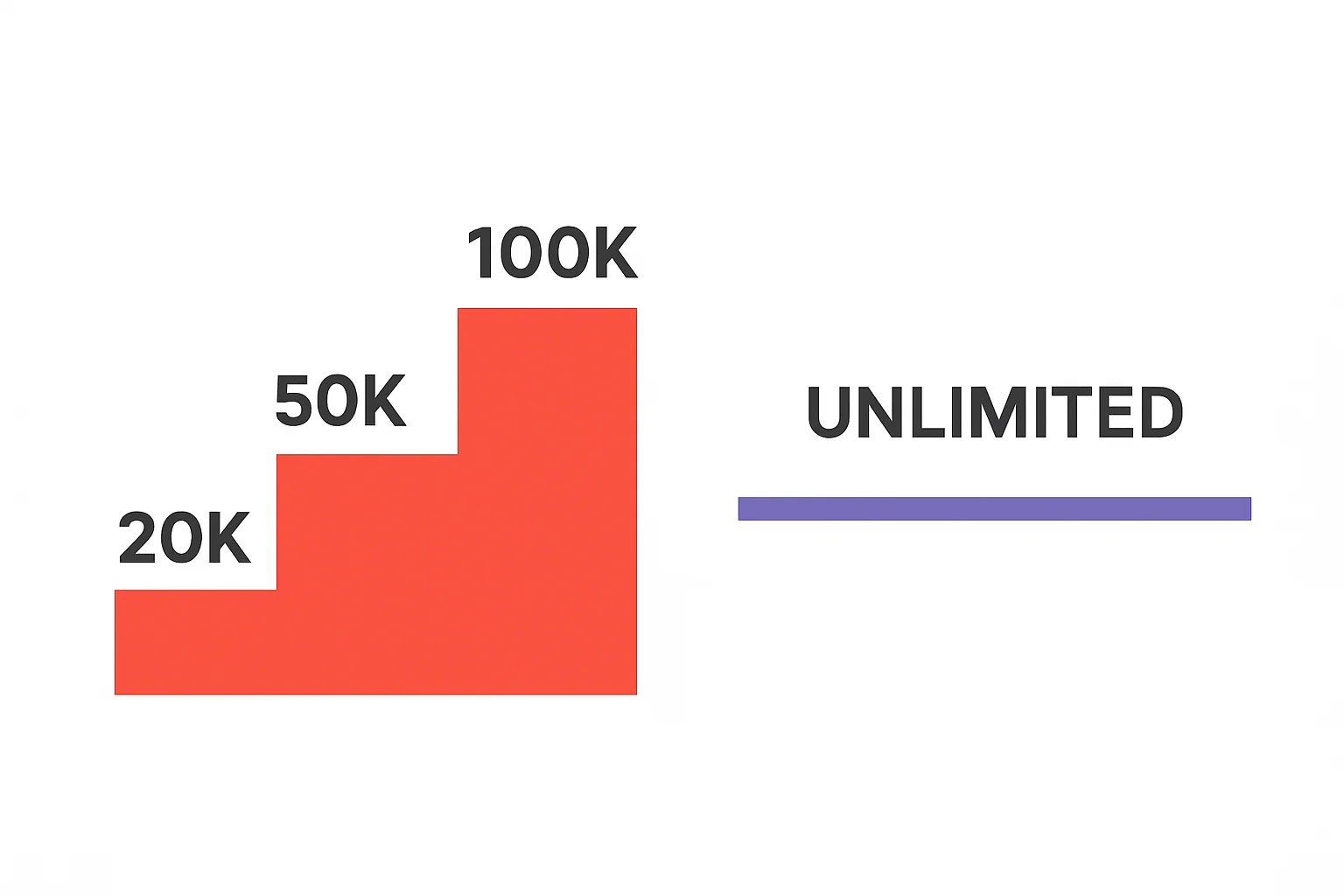
Let’s run the numbers at different scales. Here’s when unlimited makes sense versus tiered pricing.
Scenario 1: New Podcast (5K Downloads Monthly)
You’re just starting. You get 5,000 downloads per month. You publish weekly, 30-minute episodes.
Tiered pricing:
- Transistor: $19/month ($228/year) for 20K downloads
- Buzzsprout: $19/month ($228/year) for 4 hours monthly
- Libsyn: $15/month ($180/year) for 6 hours monthly
Unlimited pricing:
- VNYL: $9/month ($90/year) unlimited everything
Verdict: At 5,000 downloads, both models work. Tiered platforms are slightly more expensive ($180-228/year vs $90/year), but the difference isn’t dramatic. However, plan for growth. If you’ll hit 15K downloads in 6 months, start with unlimited.
Scenario 2: Growing Podcast (25K Downloads Monthly)
You’ve been publishing for 6-12 months. You’re getting 25,000 downloads per month. You have 50 episodes in your back catalog.
Tiered pricing:
- Transistor: $49/month ($588/year) for 100K downloads
- Buzzsprout: $19/month ($228/year) if you stay under 4 hours monthly
- Libsyn: $20/month ($240/year) for 10 hours monthly
Unlimited pricing:
- VNYL: $9/month ($90/year) unlimited everything
Savings with unlimited: $138-498/year
Verdict: Unlimited wins decisively. You save $138-498 annually compared to tiered platforms. The break-even point is around 15-20K downloads.
Scenario 3: Established Podcast (50K+ Downloads Monthly)
You’ve been publishing for 1-2 years. You’re getting 50,000 downloads per month. You have 100+ episodes in your catalog.
Tiered pricing:
- Transistor: $49/month ($588/year) for 100K downloads
- Buzzsprout: $39/month ($468/year) if you’re uploading more hours
- Libsyn: $40/month ($480/year) for increased storage needs
Unlimited pricing:
- VNYL: $9/month ($90/year) unlimited everything
Savings with unlimited: $378-498/year
Verdict: Unlimited is essential at this scale. Tiered platforms punish success. You’re paying $468-588/year when you could pay $90/year.
Scenario 4: Multiple Shows (Network Hosting)
You run 3 podcasts: a weekly interview show, a daily news brief, and a monthly deep-dive series. Combined downloads: 40,000/month.
Tiered pricing:
- Transistor: $49/month ($588/year) for 100K downloads (unlimited shows, but download cap applies across all)
- Buzzsprout: $79/month ($948/year) for 35 hours monthly (split across all shows)
- Libsyn: Multiple accounts required = $180-600/year
Unlimited pricing:
- VNYL: $15-30/month ($180-360/year) for 2-30 shows depending on plan
Savings with unlimited: $228-588/year
Verdict: Network hosting requires unlimited or costs spiral. You can’t split download caps or storage limits efficiently across multiple shows.
Total Cost of Ownership Over 24 Months
Let’s include migration costs, tier jump surprises, and overage fees in the calculation:
| Platform | New Podcast (5K) | Growing (25K) | Established (50K) | Network (3 shows) |
|---|---|---|---|---|
| VNYL (24mo) | $180 | $180 | $180 | $360-720 |
| Transistor (24mo) | $456 | $1,176 | $1,176 | $1,176+ |
| Libsyn (24mo) | $360 | $480 | $960 | $960-1,800 |
| Buzzsprout (24mo) | $456 | $456 | $936 | $1,896 |
Add migration costs if you switch platforms mid-journey: 10-20 hours of work at $50-100/hour value = $500-2,000 in time costs.
Quick Takeaway: Unlimited wins once you exceed 15-20K downloads. Savings compound over 24 months, especially for networks.
The Bottom Line on Unlimited Hosting
Cloud storage costs dropped 85% since 2010. Bandwidth followed the same trajectory. The infrastructure economics that justified download caps and storage limits in 2010 don’t exist anymore.
Yet most platforms still charge like storage is expensive. Download-based tiers, storage-hour limits, and monthly upload caps create artificial scarcity that benefits platforms, not creators.
Here’s what unlimited should mean in 2025:
- No storage caps (upload your entire back catalog)
- No bandwidth throttling (fast delivery regardless of scale)
- No download limits (viral episodes don’t cost extra)
- No deletion required (build an evergreen library)
When we built VNYL, we committed to genuine unlimited hosting because modern infrastructure supports it. Storage costs $0.023/GB. Bandwidth costs pennies. There’s no technical reason to cap downloads at 20,000 or charge per upload hour.
Our founder pricing locks in $90/year for unlimited storage, bandwidth, and downloads. We’re limiting this to 100 early adopters who want to lock in that rate permanently. No tier jumps when you hit 20K downloads. No overage fees when you go viral. No deletion anxiety when you upload your back catalog.
Calculate your savings with our free hosting cost calculator to see what you’d pay on unlimited versus tiered platforms at your current scale.